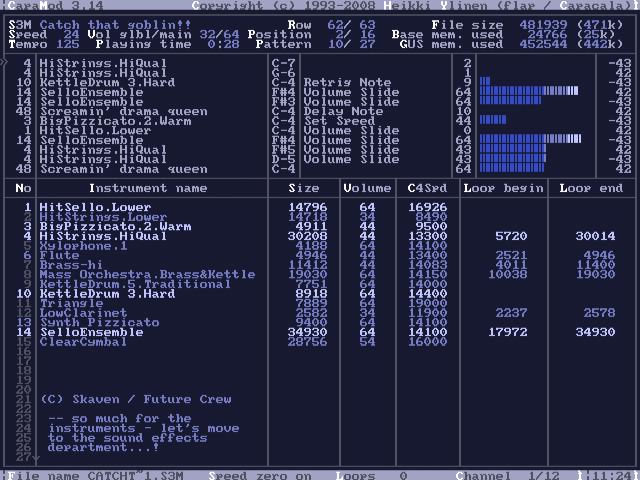
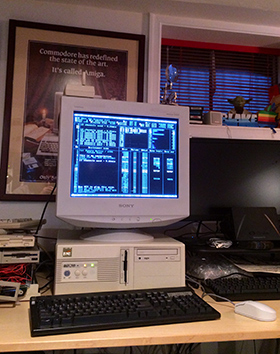
 Back in November I became inspired by the knowledge that my favorite old school DOS MODplayer had “recently” received an update, and expressed my intention (part 1) to more-or-less recreate the 486-class DOS PC upon which I enjoyed many, many hours of MOD music, scenedemos and games back in 1996 or so.
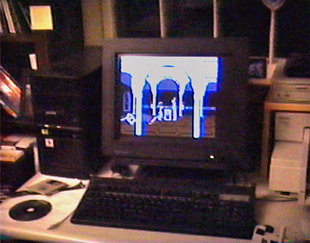
Well, it was a long road (part 2) getting everything together, but a few weeks ago I finally completed the build. I took a detour or two from the original plan but, for the most part, the PC is the same machine I was using nearly 20 years ago:
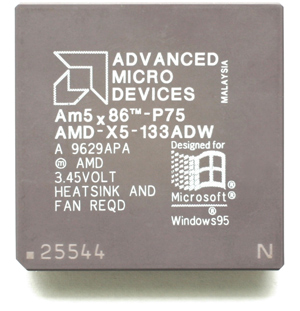
- AMD 5×86 133 (overclocked to 160MHz, making for a 40MHz bus)
- ASUS PVI-486SP3 motherboard (VLB, PCI, ISA slots) w/ 256K L2 cache, 32MB RAM
- Cardex Tseng ET4000/W32p-based VLB video card w/ 2MB DRAM
- Adaptec 1542 SCSI controller
- Seagate Hawk 1GB SCSI HD
- Toshiba 32x SCSI CD-ROM drive
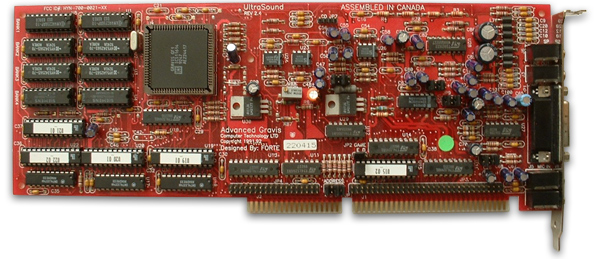
- Gravis Ultrasound (“Classic”) w/ 1MB sample DRAM
- 3Com EtherLink III Ethernet adapter
- The same Focus FK-2001 mechanical keyboard and Logitech serial mouse from my original, 1996 PC
- MS-DOS v6.22, Windows 98 OSR2.5, Norton System Commander 7
Some of the more interesting drills were trying to get a SCSI drive to work with my original DPT SCSI card (I ended up jumping over to a more widely supported, if less mighty, Adaptec card), sourcing SRAM chips to upgrade the motherboard cache as well as the oddball 24-pin DRAM chips needed to upgrade the video card to 2MB RAM, getting Ethernet networking running under DOS (with mTCP), and fixing the CMOS battery well after I snapped part of it off…
A number of twitter pals urged me to film the build, so I did, but it’s a pretty rough production, I must confess. Still, those wanting to see this system come together, here it is.
I’ve actually had more fun with the completed system than I imagined I would. I’ve got it loaded with demos and games and MOD/S3M/XMs. It’s been great fun seeing what more or less the highest spec “486” system you can build is capable of. In fact…I’ve had so much fun with scenedemos in particular that I have decided to build a second PC designed to chase down the next era of productions, the ~1997-2001 DOS demos that run in high res, high color VESA framebuffers. Socket A Athlon Thunderbird 1400C, here I come! (And, of course, I’ll bring a full report as that project unfolds.)
 I’ve spent the past couple of months procuring parts and assembling a 486-class DOS PC that is more or less a replica of the 486 PC I had back in college, in 1994. That’s the machine that first delivered the Internet to my home (by way of dial-up 28.8Kbps
 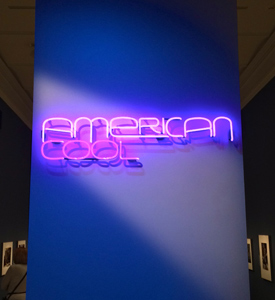 Living just out outside of D.C., my wife and I often find ourselves in the district on the weekends, taking our daughter whatever museum is at the top of her list at the given moment. Today we visited the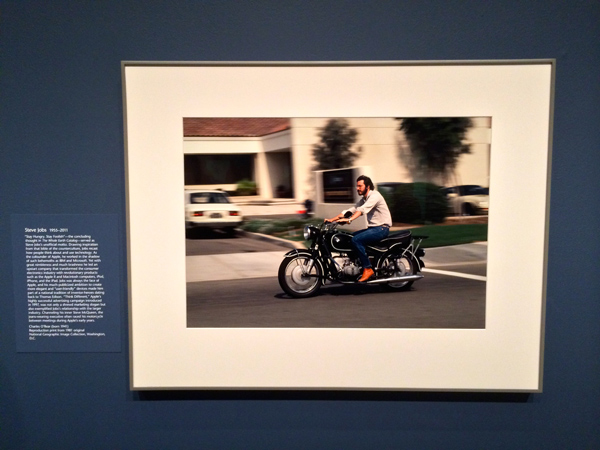
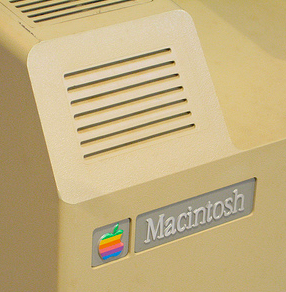
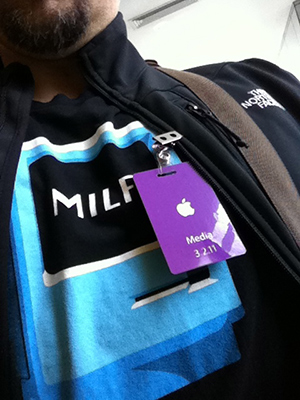 The Mac has always been, in a word, elegant. However, during Apple’s hardest times — mid-’97 or so — it wasn’t the most advanced platform out there from an OS kernel perspective. All that changed NeXT took over Apple in 1997 and Steve Jobs returned to the company he co-founded two decades earlier. That’s when OS X took shape and became the best operating system this self-proclaimed operating system aficionado has had the pleasure of using.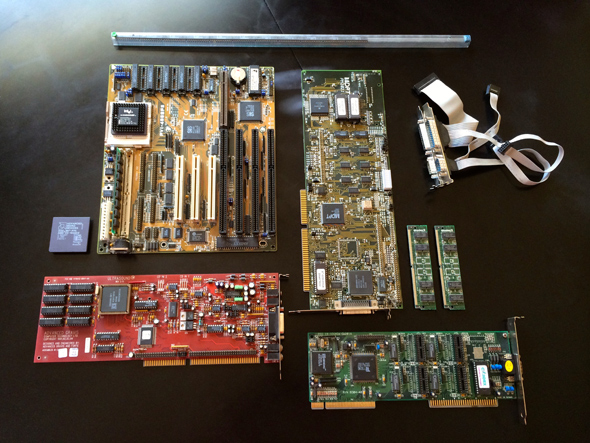
 [UPDATE: This turned into a three-part post, with a video of the build process at the end. So, read on!]
 And all the hardware was black in color, in the spirit of NeXT. I ran this system under