

Nearly two years ago I got into mechanical keyboards (real keyboards, proper keyboards) in a pretty big way. In order to truly enjoy the experience of typing on these quality boards, I decided to learn to type “properly,” as opposed to my odd (but fast) most-of-left-hand + one-finger-on-right-hand approach, and made a post about it. Not long at all after that post, I was indeed “typing properly.” It was a lot easier to learn than I imagined it would be.
As I mentioned in that post, I had ordered a Realforce 87U keyboard featuring Japanese Topre capacitive keyswitches, and I received it soon after. It is a keyboard that has an exceptional feel that’s pretty hard to describe. (I soon modded it out with a partial set of orange keycaps.) It has been my primary keyboard for most of the time since that post.
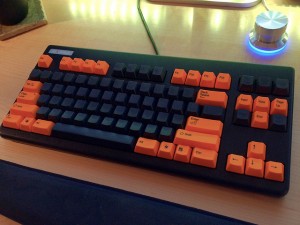
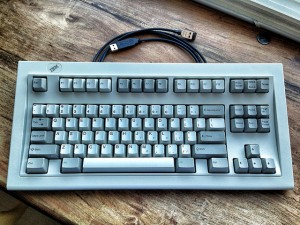
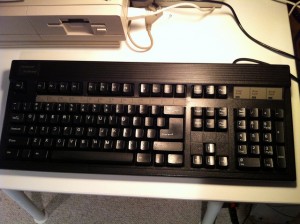
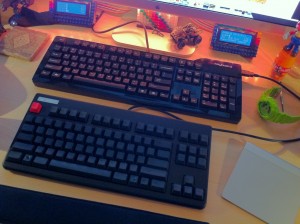
Since then, I’ve also picked up a Unicomp Classic 104 with buckling springs (basically a modern-day IBM Model M), refurbished the old Focus FK-2001 with Alps switches that I used on my 486 NEXTSTEP for Intel box in the early ’90s, stole my keyboard-happy friend Arnold Kim’s Matias Quiet Pro (with Alps-like switches — a nice board, but no superstar) and picked up a genuine IBM Model M Space Saver keyboard (buckling springs) in mint condition, as well (it’s something of a legend in the mechanical keyboard world). All of these are quality keyboards, far surpassing what comes bundled with any PC or Mac you might buy. Still, the Realforce with its lovely Topre switches has remained my favorite.
Until recently, there were only two consumer keyboards on the market featuring Topre keyswitches: the Realforce boards and the Happy Hacking Professional keyboards from PFU systems. These are expensive keyboards, make no mistake. About a month ago, however, news landed that Korean keyboard maker Leopold was releasing a Topre-based compact keyboard, model FC660C, at a more affordable — thought still rather high — price-point. It features 66 keys and uses Topre switches and, over at the keyboard forum Geekhack, the race was on for Topre-lovers to get their hands on one of these brand new boards. (And getting one outside of S. Korea is a challenge.)
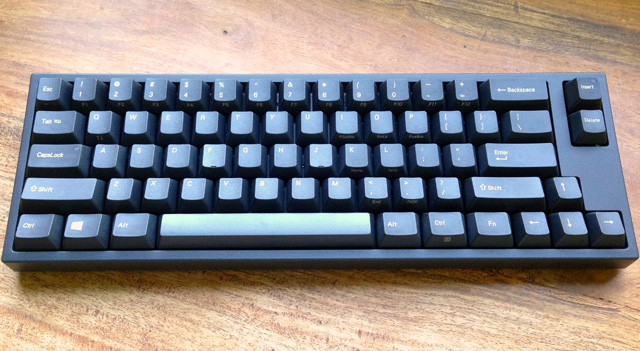
After watching things at Geekhack for a few days, I saw that LA-based EliteKeyboards.com made a post indicating that they were about to receive a small batch of FC660Cs — 30 or so — with more to come in a month or two. I “kept a close eye” on their website for the new keyboard to appear and, when it did, I quickly ordered one. A few days later and I’m typing on it.
Now, I’ve tried most types of keyswitches out there. Alps, Cherry MX, buckling springs, Topre, scissor switches, typical rubber domes, etc. Of them all, I find Topre switches, which are basically domes of unusual quality combined with a capacitive, low-reisistance spring, the most to my liking. What surprises me, thought, is that I actually prefer the feel of the 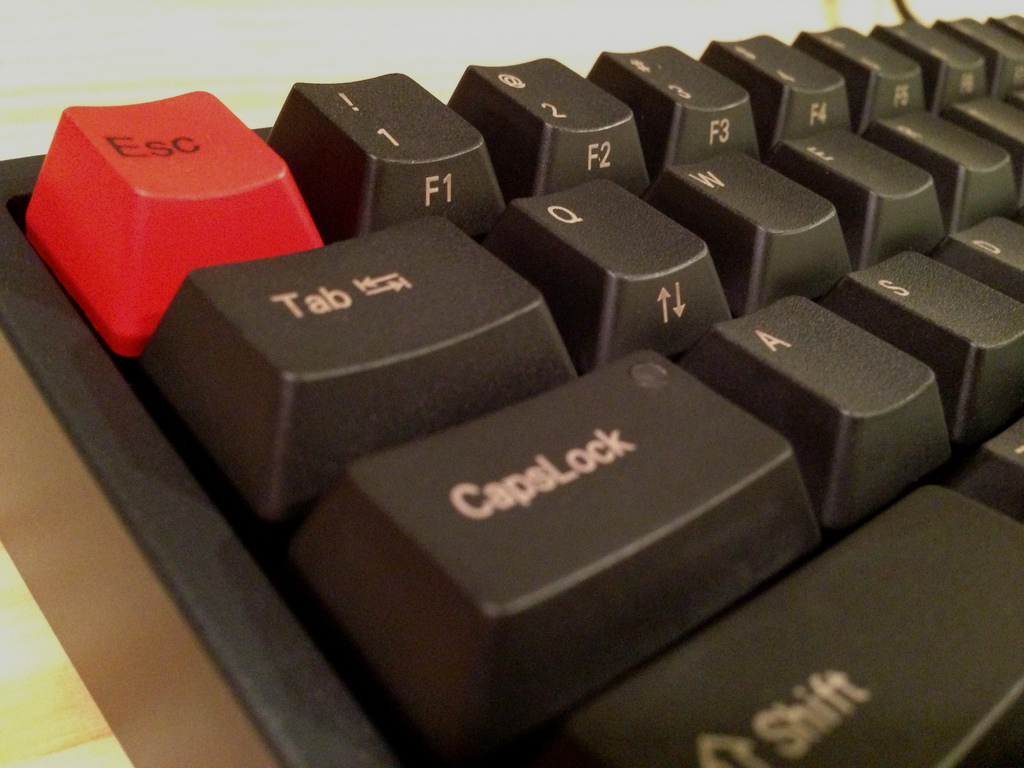 less expensive Leopold board to that of my Realforce 87U. Topres bottom out with a satisfying “THOCK,” and the Leopold’s “THOCK” is just…a bit more satisfying.
I initially wanted the FC660C to use in the standing-desk setup I’ve got going in the kitchen on the main floor of the house. The Realforce has been living on my iMac in the basement computer room, and I thought that a nice secondary keyboard on the standing-desk would make for a great set of workstations to alternate between in order to mix up the workday. (Also, I wanted both machines to have “tenkeyless” keyboards — those lacking a number pad — as it makes for better / closer trackpad positioning.) Given my unexpected preference for the Leopold, however, I believe it will be taking up residence on my main machine, the basement iMac, while the Realforce moves upstairs to the standing desk.
They’re both exceptional keyboards, but for the money, the Leopold FC660C takes it, I think.
One of the things that creepy keyboard nutballs like myself enjoy doing is listening to the sweet music that is made when these keyboards do their thing. There are lots of videos of mechanical keyboard fans fingering their precious hardware on YouTube. I’ve watched many of them and, given how little time the FC660C has been on the market, I thought I would take the opportunity to make my own typing video for the first time, to help convey the lovely sound that issues forth from this great new keyboard as I type upon it, for those that may be considering the purchase. The sound, to me, is like rain gently falling on a wooden cottage, somewhere deep in the forest. Soothing and, oh, so sweet…
Enjoy the video and, if you haven’t already, I urge you to consider investing in a “real” keyboard of your own.
UPDATE Feb 2014: I picked up a second FC660C for the office in town!
You and your keyboard porn!
I must say though, that it is very compelling and I would love to live with a mechanical keyboard for a while just to see what all the fuss is about. I think I probably need to improve my typing too; I’m currently using about 8 of my 10 fingers, but my hands are all over the keyboard, and it’s frankly a bit of a mess.
Is there a board you would recommend for a noob looking to get a sense of the mechanical without spending too much money? I’ve had a look around, and it seems that they are harder to get hold of here in the UK. Any advice you have regarding this and improving my typing technique would be gratefully received.
Sweet mother of God that 660C sounds so satisfying.
Marc,
I would recommend the Leopold Tenkeyless Tactile Touch Keyboard with Cherry MX Brown Switches. It’s a solid starter and I believe you’ll enjoy it.
For what it’s worth, you guys in the UK do have a reseller of various mechanical keyboards: http://www.keyboardco.com/ (Being in the US, I’ve never done business with them, though.)
Myself, I’m a fan of buckling spring keyboards, Unicomp being the current maker of those. And, The Keyboard Company does resell Unicomp (listed on their homepage as “IBM style”), as well as Filco, Matias, and Topre (so, basically every type of switch in current production is available from them).
Thanks Joe, I’ll check it out. I was leaning towards brown switches, I like the idea of tactile feedback without driving my wife crazy with the clickity-clack!
My main PC has a 1995 Model M attached to it that I bought off someone online for the bargain price of £30. I clatter away happily on it each night – once I was asked to turn the volume of my typing down because it was disturbing the TV :-)
I’ve just bought a new laptop – a 12″ Lenovo x220, and the keyboard on that is really nice too. It’s nothing too special, there’s probably a squishy rubber dome membrane under the buttons like all laptop keyboards. However, in this modern age of Apple-wannabe keyboards that have that stupid chiclet style it’s really nice typing on something that looks like it’s not been redesigned since the original IBM laptops of the 90s. It’s a nice, firm keyboard that has just the right amount of tactile feedback to stop you pounding the buttons too hard. And unusually for a laptop, the whole keyboard doesn’t bend when you type on it.
The Leopold FC 660C is intriguing. However, given the issues adjusting to a Fn layer and the fact that the length of the FC 660C is not that much less than a standard TKL board, such as a Filco or Leopold, what is the advantage of the FC 660C over a TKL board? How would you compare the FC 660C to the Filco Minila?
BTW, apparently the Leopold is also available with Cherry switches: model FC 660M.
Do you know if the keycaps on the Leopold FC660C can be replaced by Realforce 87u keycaps (except for the oddly sized spacebar)? Thanks.
Highly recommend keyboardco.com if you’re in the UK. All of my recent boards have come from them. They’re offer a decent selection of high-end boards, free next day delivery, and service is top notch.
I saw your IBM Spacesaver that comes with custom USB cable, where do you get that cable?
eBay user orihalcon sells them.
http://www.ebay.com/usr/orihalcon
Here’s one now:
http://www.ebay.com/itm/280862986246?ssPageName=STRK:MEWAX:IT&_trksid=p3984.m1423.l2649
Hey I really liked the article about your adventures into mechanical keyboard world. I am currently myself getting into different types of mechanical keyboards, and I have to say have becom very passionate about. I still have a lot to learn about modding mechanical boards, but I am eager to learn how to do. Now I know you were saying after trying multiple types of mechanical boards and others that you still enjoy your topre switches the best. I actually am currently typing on a cherry mx blue switch, cooler master rapid, and have another with cherry browns. I happen to enjoy both keyboards a lot, but my friend, knowing I am in search of a new switch to try with a different size board, has been talking to me about his topre switch board, the Leopold 660c, and how much he loves this keyboard. And he actually came from typing on blue switches and still enjoys this topre board that much as to make it his daily driver at home and at work. I really have been researching and have been on the fence, because I will be getting a new keyboard next week. It is up between a couple different switches: the topre switches of the leopold 660c and the cherry mx clear version of the leopold fc660m. I believe I am now leaning towards the topre, and the thing is they are about 45 dollar difference maybe a bit more with shipping. I just wanted to ask if you are still enjoying this keyboard as much when you first wrote this article and posted the youtube video? Because I am hoping this keyboard is truly for me because it would make my holiday all the more happier finding a keyboard that I love(like the cherry blues alot but cannot bring them to the library or late at night with gf sleeping) Please write me some feedback about this keyboard, and I would definitely appreciate it very much.-Patrick
Thank you for sharing the story, tore has been tempted for me too.
I have been using a Leopold FC660C for a few weeks and really like it. It is the best typing experience I have ever had. I have one question.
There are small lights on the Insert key and on the CapsLock key but they have never come on. What are they for?
I’ve been on the hunt for a compact keyboard, and your review of the Leopold FC660C has really piqued my interest! The build quality and the sound of the switches sound amazing. I love that it combines great aesthetics with functionality. Definitely considering adding it to my setup! Thanks for the insights!
The comparison with the Realforce is the detail that stuck with me: both use Topre switches, yet the FC660C’s slightly more satisfying “thock” is enough to change which board gets the main desk. A nice reminder that the feel and sound aren’t just about the switch itself—the whole keyboard matters.