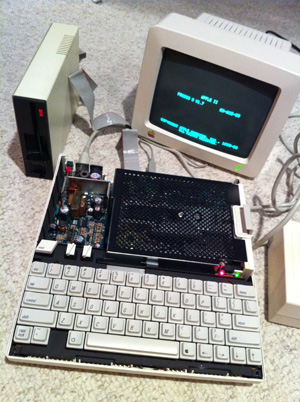
The Demco Graphics Tool Kit – An Apple II Video Board

A couple months back l was enjoying a glass of wine and flipping through the November 1986 issue of A+ magazine, which covered the newly announced Apple IIgs. I remember reading the very same magazine back in ’86 as if it were yesterday. (I love my GS.) At any rate, I noticed an ad for a curios expansion board for the Apple II, the Graphics Tool Kit from Demco. It triggered a deep memory.

Back in early ’86 I was using had an Apple IIe. I recall seeing ads for this interesting looking Graphics Tool Kit, which promised to bring better-than-Macintosh resolution graphics–640×384 pixels–to the humble Apple II. It featured all of 64K of video RAM and a mouse port. I wanted one badly, but at $399, there was no way that 13-year-old me could scrape that kind of cash together, so I just lusted. I think I might’ve sent in a Reader Service Card (remember those?) for more info. I just wanted to be teased.

Remembering that, I did a quick Google search on “Demco”. It turns out the company is still around. So I sent off an email asking if anyone was still around that worked on the GTK. As it turns out, Demco president Darrell Hoblack designed the device. I asked if he minded a quick interview, and he was game. Highlights follow.

    B: Thank you for your time. I just have a few questions. Can you tell me why Demco was prompted to create such a device as the Graphics Tool Kit?

    Hoblack: First of all, we started this before the Mac had come out. If you’ve ever tried to do any graphics on the Apple II, it was just next to impossible.

    B: Right, very low res.

    Hoblack: Yes, the capabilities weren’t there, so we came out with the Graphics Tool Kit which came out about the same time the Mac did and actually gave better graphics capabilities than the Macintosh did.

    B: Right, 640×384 with a dual-screen framebuffer.

    Hoblack: Basically, one of the reasons it never really got going was that Apple didn’t want it to be publicized because it gave you better graphics capabilities than the Mac. For example, the Mac couldn’t do an 8.5 x 11″ sheet of paper. There would be about an inch border on one of the sides and almost a two inch border on the bottom that you couldn’t get to. With our graphics board, if you wanted to draw a line from the top to the bottom of an 8.5 x 11″ page, you could do that in one stroke.

    B: Why make it for the Apple II instead of a PC?

    Hoblack: Well, we started on the Apple II and were making other devices for the Apple II computers, and we got into this and one thing lead to the next

    B: Did any 3rd party companies make apps for the GTK or was it pretty much just your bundle?

    Hoblack: Mostly it was the software from us. It came with a complete software package but we did incorporate the Mac fonts and all the Mac clip art that was available for it.

    B: Interesting, I didn’t realize that. I’ve never been able to find any screenshots of the board in action, rendering to a screen, unfortunately.

    Hoblack: Our brochures showed screenshots of the board in action.

    We got criticized very badly for not having windowing. The reviewer who did the criticism had two problems: first, he never even turned the device on to try it out, and secondly, he never commented to readers that the reason we didn’t have windowing was that we didn’t need windowing. We showed you the whole width and it automatically scrolled down to the bottom of the page, so windowing wasn’t a necessity.

    B: Did the board work with a standard composite monitor or did it need some specialized display?

    Hoblack: We recommended a high persistence phosphor display because of the interlacing.

    B: Such as Apple’s slow-phosphor Monitor ///

    Hoblack: It worked perfectly with that Apple monitor, yes.

    B: Do you have a ballpark idea of how many units were sold through the production run?

    Hoblack: A few hundred–it was low volume. By the time we got it out there, the Mac took off and everybody was switching and everybody who wanted to do graphics on an Apple product was switching to the Mac.

    B: Were there any particular challenges in getting the board to work with the host Apple II? Obviously your board was much more capable than the II’s integrated video hardware…

    Hoblack: Basically the board was another Apple. It had a CPU, its own memory, its own operating system, a built in mouse controller, multiple video pages you could work on. It had a lot of really nice features. I used it for years to do all kinds of drawings, schematics, and things of that nature. It was so much easier than what was available at the time.

    B: That drawing package that came with the toolkit – I know it wasn’t a windowed Mac Paint clone, but did it feature all the circle, square, line tools and whatnot that people might have expected?

    Hoblack: Oh yea. Not only were there circle tools, but we compensated for the aspect ratio for printers. You drew a circle on the screen and you’d get a circle on the printout.

    B: Very interesting – it sounds very advanced for the time. I recall very much wanting one back when I was seeing the ads in magazines in ’85 or ’86, but as a 13 year old it wasn’t very easy to come by the $399 purchase price.

    Hoblack: Well, it’s one of those things. You make a million and you could sell it for a dollar, you make one and you’ve got to sell it for a million. And that’s what the problem was. We had a tremendous amount of engineering that went into it–it took years to get it all together. There were at least three versions of it that came out. People would complain that they didn’t have a lot of slots available in their Apple IIs, so we came out with another version with a mouse controller on it, saving a slot. Then we came out with a third version where we added the two graphics pages you could work on at one time. Each version had tremendous improvements. The last one I used for years–it was just much easier than using any other machine.

    B: Of course, Apple had their 80-column card out there, and I recall that a few companies had compatible boards that featured a higher res display and could go, say, 120 columns on a text screen, etc. Could your board get that going?

    Hoblack: Well, it was pretty much with our software. Things could’ve been made to add to it, for example, we had it so you could program in BASIC directly to it, so if you wanted to write your own little graphics program or charting or whatever in BASIC, you could output right to our card.

The interview was quite a throwback for me. Frankly, I wish Hoblack had informed me he had an unsold board lying around and offered it to me. But, alas… It feels good to let folks know about this unique piece of hardware that surely passed most by.

Posted in Apple II | 6 Comments

Tempest and Jaguar and Nuon — Oh My!

I remember how great video games were when I was a kid. “Real” video games. I’m talking early ’80s. And I say “real” because, quite unlike the situation over the past 10 years, home computers and consoles were not anywhere near as able to toss around the sprites as the wonderful towers of electric sex in the arcade down at the mall. The good old fashioned arcade down at the mall.

When I think back to the magical feeling of looking around the arcade, amid the beautiful chorus of blips and beeps, for just the right game to play…and slipping a quarter in the slot…I get a little teary eyed. Yea, that was the stuff. And to the young folks out there (I’m an old fart of 36 years): what you call an “arcade” today is, sadly for you, an insult to the term. They just don’t make ’em like they used to. And people don’t really care that much anyway because they have a PS3 at home.

Of those magical golden-age games, one of the very best was Tempest. Atari’s first vector offering, Tempest is a frenetic, spinner-controlled shooter where the player controls a claw that rides the edge of various oddly-shaped 3D tubes and walls, shooting at enemies that approach from below. It’s just about perfect. And it’s just as playable today as it was back in 1981.

A few recent additions to my own, personal “Byte Cellar” illustrate my fondness for the game.

Not long ago I purchased a new-in-box Atari Jaguar, complete with Jeff Minter‘s (great photo here) psychedelic sequel to Tempest, Tempest 2000. It’s an amazing game that’s been ported to many other platforms, but the consensus is that none are as solid as the Jaguar original. Having played several of the ports, I’d have to agree.


Tempest 2000 gameplay

An interesting thing about “the world’s first 64-bit console”–it’s controller was, as the Brits would say, fairly pants. It was large, sported a calculator-button array for game overlays (like the Intellivision controller), had no shoulder buttons, and featured only a D-pad for directional control. As the arcade original is controlled with a rotary spinner knob, the D-pad falls rather short of providing ideal game control. But, of course, being such a savvy chap, Jeff Minter realized this.

Jeff wrote in support for an analog rotary controller…one that did not exist. Neither Atari nor third party manufacturers produced such a controller in the Jaguar’s heyday. Jeff, as I understand it, hacked his own together by wiring an Atari paddle controller into a Jaguar controller. In the years since the Jaguar’s passing, a few small operations have offered modified Jaguar controllers with spinners wired into them for purchase. The best one I’ve seen is the Jaguar ChaosReins Rotary Controller.

A few weeks ago I ordered. It arrived. Gaming ecstasy ensued.

After activating the hidden controller mode in Jaguar 2000 by depressing the magic button combination across two plugged-in controllers, the already-amazing game jumped to a whole new level. My first game on the new controller nearly doubled my previous high score. Hats off to Jeff for doing the right thing and supporting the hypothetical!

But he didn’t stop there. Not long after creating T2K for the Jaguar, Jeff found himself working with VM Labs to create software for their in-development “Project X” system. I recall reading about the mysterious and promising Project X in Next Generation magazine back in ’96 or so. Well, Project X was released as Nuon, a gaming chipset that took a rather new approach to distribution: it was embedded in various DVD players to add not only gaming capability but also enhanced media capabilities like flexible zoom options, enhanced on-screen menus, visualizations for CD audio, etc. It was finally released in several DVD player models…but no one really seemed to care.

Most Nuon owners were likely unaware that they had access to a rare gaming gemstone–perhaps Jeff Minter’s magnum opus: Tempest 3000.


Tempest 3000 in action

While Tempest 2000 was a rather psychedelic gaming experience, Tempest 3000 is like just way too many ‘shrooms. The colors just drip out of the screen, the tubes and walls flex and bend as if floating in a gentle wind, the yak bleats on the level jump caress your senses, and the action is as intense as ever. And, while I’ve not seen a hacked-up rotary controller for T3K, the analog stick featured on most Nuon controllers is fully supported, offering control far beyond the D-pad.

And, of course, I know all of this becuase, after becoming addicted to the gaming crack that is Tempest 2000 with a rotary controller, I went out and found a Samsung DVD-N501 “Nuon enhanced” DVD player (featuring a 54MHz VLIW Aries 2 processor) on eBay, complete with a three-game bundle including the holy grail itself. And if you’re guessing that I’ve dreamed more than once in the past few weeks that I’m teetering on the edge of a tube, dodging approaching Flippers and Spikers, you’d be correct. The bleeding eyes came as a bit of a surprise, though.

If you aren’t prompted to go right out and grab a Jaguar and a Nuon and settle down with lots of chips and Coke, then at least have a look at a few offerings you can try without getting off the couch. Stainless has brought Tempest to the Xbox Live Arcade for 400 MS Points (and they may soon be bringing it to the iPhone–let’s hope!). But, perhaps more interestingly, Jeff Minter himself has produced a Tempest-inspired game (that as he reminds players “is not Tempest!”) called Space Giraffe. And, though it seemed impossible, Space Giraffe is even more psychedelic than T3K–it’s sort of like acid-induced psychosis (that’s what happens when our giraffe is in another castle, after all). It’s definitely worth the 400 MS Points. And for no charge at all, look at the XBOX 360’s music visualizer–it’s Jeff’s light synth handiwork all the way.

UPDATE 1/12/2019: A couple of months ago I grabbed a Playstation mouse on eBay in order to properly play the classic Alien Resurrection. It’s lovely, and so is Quake II played with the mouse. Since then, I found a list of PSX games that support the PS mouse and among the titles is Tempest X3 for the Playstation. It’s a conversion of Tempest 2000 for the Jaguar (and it actually has an unlockable Tempest 2000 mode hidden away!) which I find to be solid, but not quite as nice as the Jaguar original. I gave it a spin and I can tell you that the mouse control is amazingly good, as you can imagine. Next to the Jaguar with rotary controller, it’s the best way to play the a Tempest sequel.

Posted in Atari, Gaming, Other Platform | 15 Comments

I Think I’m Going to Get an Apple Tattoo…

I think I am going to finally go ahead and get an Apple tattoo.

A plain, black-on-flesh Apple logo. This will be my third tattoo.

I didn’t want it to be as prominent as my Space Invader tattoo, and so I thought I’d get a rather small one in the vicinity of an ankle, but my wife (who is not in favor of my getting this tattoo) thought that might be a somewhat “girly” location. She actually suggested the other shoulder. In her opinion, since I don’t walk about the world shirtless too often, it would be less prominent there than the ankle anyway.

But I don’t know.

I’d love suggestions from you folks out there as to what might be a good location to be inked. Thoughts? Thanks.

Posted in Just Rambling | 13 Comments

Geek Classic “WarGames” Comes Back to the Big Screen!

That’s right! It’s been 25 years since we sat in that theater and saw John Badham’s “geek’s wet dream” masterpiece WarGames on the big screen. A quarter of a century. I was 11 years old. And even though I’d had my first computer for about half a year at that point, it was primarily responsible for permanently burning into my brain a boundless, lifelong lust for computer hardware. It solidified me as a geek, and for that I thank it. And as you may be suspecting…I’m not the only one who drank the Kool-Aid…

And the best part? We’ve all got one more chance–one single chance–to be a kid again, sitting there in awe before the silver screen. On July 24th at 7:30pm in theaters all around the country, WarGames will be projected upon the silver screen once more. Tickets are on sale now at the event site. (I’ve got mine!) What a splendid night it will be. It’s kind of like Christmas, really.

The event runs for 2 hours, 20 minutes and includes the geek classic WarGames along with previously unseen interviews and a preview for…get ready…the forthcoming sequel to WarGames, WarGames: The Dead Code. Only today did I learn of this sequel. And it excites me. Though it’s a direct-to-DVD release. And it looks fairly lame. But hey–who are we kidding? We’ll all own it.

I’m pleased to be able to share this info that I happily stumbled upon in the Twitterverse. Don’t miss your chance to relive the dream. And for those geeks who’ve yet to experience this wonderful piece of cinema: thank all the powers in the universe that you can enjoy it for the first time as God intended.

And for a really nice WarGames treat, have a look at this most interesting story of the IMSAI 8080 used as the prop for David Lightman’s home computer setup. It’s a great read.

Posted in Just Rambling | 4 Comments

Radiohead’s “Nude” Played On Vintage Hardware

This is one of the most amazing things I’ve ever seen. I had to share.

As creator James Houston explains,

    I’ve just graduated from the Glasgow School of Art’s graphic design course. This was my final project.

    Radiohead held an online contest to remix “Nude” from their album – “In Rainbows” This was quite a difficult task for everybody that entered, as Nude is in 6/8 timing, and 63bpm. Most music that’s played in clubs is around 120bpm and usually 4/4 timing. It’s pretty difficult to seamlessly mix a waltz beat into a DJ set.

    This resulted in lots of generic entries consisting of a typical 4/4 beat, but with arbitrary clips from “Nude” thrown in so that they qualified for the contest.

    Thom Yorke joked at the ridiculousness of it in an interview for NPR radio, hinting that they set the competition to find out how people would approach such a challenging task.

    I decided to take the piss a bit, as the contest seemed to be in that spirit.

    Based on the lyric (and alternate title) “Big Ideas: Don’t get any” I grouped together a collection of old redundant hardware, and placed them in a situation where they’re trying their best to do something that they’re not exactly designed to do, and not quite getting there.

    It doesn’t sound great, as it’s not supposed to.


Big Ideas (don’t get any) from James Houston on Vimeo.

That’s right. James created a mix of Radiohead’s “Nude” using the following:

  • Sinclair ZX Spectrum: Guitars (rhythm & lead)
  • Epson LX-81 Dot Matrix Printer: Drums
  • HP Scanjet 3c: Bass Guitar
  • 10 Hard Drive array – Act as a collection of bad speakers: Vocals & FX

An amazing show of modern creativity using tools of our favorite bygone era. Hats off, James!

Posted in ZX Spectrum | Leave a comment

Uthernet in my Apple IIgs

Back in April I made a post regarding the Uthernet card, Ethernet for the Apple II. As I indicated, I laid down my $89 and ordered one as soon as I learned that a2RetroSystems was selling a new batch. It promptly arrived and I promptly threw it into my Apple IIgs. Let me tell you about it.

The hardware install was rather straightforward; I just dropped the card into slot 2. As for the software, I wrote out an image of Contiki and also installed the Marinetti TCP/IP stack for GS/OS. To my surprise, Contiki provides a much more full-featured web suite than Marinetti and the available GS/OS Internet apps I’ve been able to find, which I find to be an unfortunate situation as I’d hoped to use the graphical WIMP interface of GS/OS for most of my IIgs net activity as opposed to the text-based interface of Contiki. Perhaps this will change down the road. (Any suggestions on useful GS/OS web apps would be most appreciated.)

So far I’ve browed the web, chatted on IRC, performed various FTP operations, and fiddled with tenet on the IIgs using Contiki. The most valuable of these functions to me is FTP, as it was always a massive hassle to get an Apple II disk image downloaded from the net my Mac Pro to the IIgs–my previous drill had me routing the image through my Mac Plus. Now it’s cake. As well, It’s great fun to mess around on the net in general using the IIgs.

My $89 was definitely well spent. I had, for some time, contemplated the purchase of a LANceGS Ethernet card which debuted a few years earlier than the Uthernet, but its higher price always kept me from making the leap. It’s great to have found a route to Ethernet on my IIgs for under $100.

Have a look at my IIgs photo gallery and get a look at the Uthernet board. Thanks a2RetroSystems. This is what retro computing is all about.

Posted in Apple II | 6 Comments

Web 2.0? It’s “Brain 2.0” I say.

For the past week or so I have had basically no connectivity via my normally blazing fast Comcast internet connection. It’s up for brief moments, but that’s it. It’s rather unfortunate as Arnold Kim and I are trying hard to make Touch Arcade the end-all reader destination for iPhone gaming news. But it’s turned into a bit of an academic evaluation of my life as a hardcore geek.

I have been using the net more than casually for, well, ever. I had a home PPP connection back in 1994. That was early. In 1997 I had my first high-speed internet connection. Since then it’s been more or less golden at home. Well, the net has eluded me in my home for the past few days.

And I just can’t cope.

A while ago I embraced Facebook and it’s gotten me in touch with schoolmates I’ve not spoken with in 15 years. Lovely. More recently I have embraced Twitter and a few other social networking services as part of my daily routine. Without the net, my inability to “tweet” my latest inconsequential event has left me feeling utterly…out of my element. I have come to realize I am more dependent than I have ever in my life been on technology. And I don’t apologize for it. I warmly welcome the fact that I need to tweet about how a drink I’ve never ordered at Starbucks before tastes. I do not apologize for the fact that I need to post iPhone game news on my new site Touch Arcade late into the night.

The lack of immediate web access makes me realize that–yes, what I most want is a discreet, headset HUD and a chorded keyboard ball to finger on the streets as I walk about my daily life–a daily life that now is rather fully tied to the web. Am I an internet addict? Perhaps. Is everyone else a “talking addict?” It’s really the same question.

I hope the Comcast tech scheduled to visit me early on Friday morning can ease my pain. Else…what am I to do?

Posted in Just Rambling | 2 Comments

Newton Poetry: An Active Newton Blog…In 2008

As my readers are likely aware, I’m a big fan of the Apple Newton. I consider my MessagePad 2100 to be the finest PDA I’ve ever owned, relatively speaking. That said, imagine how surprised and happy I was to run across an active Newton blog!

Have a look: Newton Poetry: MessagePad Jabberwocky

So what’s it all about? As Dave Lawrence who runs the site describes it, Newton Poetry is…

    A blog about Apple’s MessagePad, Apple in general, and Newton Poetry.

    What’s Newton Poetry? I find a poem. I input it into my Newton MessagePad 110. The Newton galumphs and translates the text, and spits out Newton Poetry.

As you might have guessed, the site was inspired by Gary Trudeau’s famous August 1993 Doonesbury comic strip which lampooned the early Newton’s (less than ideal) handwriting recognition. It’s a nice mix of the amusing poetry translations and Newton news and thoughts.

I’m very glad to have found it. Strong work, Dave!

Posted in Handhelds | Leave a comment

MyAppleSpace: MySpace For Those That Don’t Suck

I just ran across MyAppleSpace. It’s pretty much MySpace for those that don’t suck. But then I’m pretty heavily Apple biased. I wanted to share. It’s really well done. If you’re of the brotherhood…sign up!

I created two retro groups within the network: Apple II Users and Classic Mac Users

Here’s me: http://www.myapplespace.com/profile/blakespot

I like. Have a look!

Posted in Just Rambling | 2 Comments

My New TRS-80 Model 4

In my last post, I mentioned that I had rearranged my basement computer room to make room for a new addition to the Byte Cellar. Well, my latest acquisition finally arrived: a TRS-80 Model 4, my first Tandy / Radio Shack computer.

My first memories of the Model 4 are from way back in the summer of ’83. There was a Radio Shack in the mall my mom used to frequently drag me to when I was but an 11 year old geek. This one day, this particular Radio Shack had setup a computer display in front of the store, out in the mall. I sat down at a Model III and fiddled with it a bit. I was using a TI-99/4A at the time and recall really liking that Model III. I asked the woman running the display all about it. She mentioned that the Model 4 was about to be released and that, if I was going to jump, it would be better to wait. Well, I wasn’t about to jump on anything, but it was the first time I’d heard mention of the Model 4.

A big part of why I wanted that TRS-80 is because its form-factor always, to me, represented the image of just what a computer should look like. Its design is perfect, for what it is — screen, drives, keyboard all in just the right place. I wanted to sit in its presence and feel its keyboard and bask in the glow of its 12-inch monochrome CRT. So I bid and won the eBay auction and in the mail it went. And that’s where the adventure began.

This unit was shipped to me by way of the U.S. Postal Service. I’ve often said that J. R. R. Tolkien’s immortal classic The Lord of the Rings could have been a lot shorter if it had simply been decided at the council of Elrond that the ring would be shipped to Morder by way of the USPS. There is no question that it would have been utterly destroyed. So, as you may have guessed, damage ensued.

Upon initial power-up, I discovered two problems: several keys were not registering and the system was not recognizing its floppy drives. Upon opening the case, the cause of the problems were quickly apparent. Jostling during shipping caused the floppy drive controller’s power cable to come loose. Quickly remedied. A look at the bottom of the keyboard, however, revealed a more complex problem. It seems that somewhere along the line a postal worker dropped the package from the top of a mail truck…or something like the same; something caused the TRSDOS document binders to impact the keyboard hard enough to thrust the mid-keyboard support peg through the keyboard’s PCB. It wasn’t pretty. Happily, soldering three bridge lines to the proper key contacts got the keyboard back in working order.

As regular readers will have already guessed, the first thing I did was to set up the Model 4 as a text terminal to my Mac Pro. Omniterm Plus, a hand-made null modem cable and a few magic words in the OS X terminal was all it took. Using vintage machines in this way gives me such a great excuse to finger their keyboards regularly. Some people are serial killers — I’m a serial terminaler, it seems, as this is my fourth such project (one, two, three).

That said, moving through the various TRSDOS and CP/M apps I’ve got on hand is most interesting. I’m expecting to have much fun with this machine in the coming months.

Have a look at my photo gallery as well as the “TRS-80 Love” Flickr group I setup.

Posted in Other Platform, Serial Terminal | 7 Comments