‘MYST’ for the iPhone and iPod touch Hits the App Store

I apologize for the lack of posts of late. I’ve been focusing enormous energies towards Touch Arcade, the iPhone game review site that I run with Arnold Kim of MacRumors (and now Eli Hodapp). It’s rather taxing work, given the traffic in the App Store. Apple recently saw the billionth iPhone app download and there’s no sign of things slowing down. The Newton’s gone, but it looks like, at present, Apple has the most compelling PDA on the market. Go figure.

One of the most recent and notable games we’ve seen hit the App Store is the iPhone port of Cyan’s 1993 release, MYST. As regular readers are aware, I’m a huge MYST fan. I played and solved the game in 17 hours across a rainy Saturday and Sunday with my then-girlfriend, Molly. It was, and is, an amazing game. I consider it to be one of the five best games I’ve ever played.

MYST for the iPhone [App Store] is, well, MYST…for the iPhone. The touch interface in this version is great and I’m thrilled that a new generation of gamer will be more easily able to experience the magic that is MYST. Not long ago, I purchased the game for the PSP, but, of course, I never have it with me and so my efforts to relive the magic floundered. That is soon to be corrected, as I go nowhere without my iPhone (I feel truly naked without it) and will finally have the opportunity to again work through the game, here 15 years later.

See our Touch Arcade MYST gameplay video and release story.

If you have an iPhone or iPod touch and have or have not experienced this game, you owe it to yourself to pick it up. MYST is gaming excellence. Yesterday, and today.

Posted in Gaming | Leave a comment

The Woz on Dancing with the Stars

Steve Wozniak, co-founder of Apple, was on “Dancing with the Stars” last night.

And he danced. And he wore a pink boa.

Enough said.


[ Full HD version | Low Bandwidth version ]

Entertainment News provides a little background. This guy is a machine.

Posted in Just Rambling | 1 Comment

Happy 25th Birthday, Macintosh!

On this day twenty five years ago, January 24th, 1984, Apple introduced the Macintosh personal computer to the world. It was the first computer sporting a graphical user interface that was remotely affordable to individuals. (Apple’s Lisa, which preceded the Macintosh by a year, was the first commercial computer with a GUI, but it retailed for $10,000 while the faster Macintosh debuted at $2495.)


My original 128K Macintosh

Seventy-four days after the introduction of the Macintosh, 50,000 units had been sold. The Mac didn’t exactly fly off the shelves, but it’s impact on computing was profound. And, what’s more, in case you hadn’t noticed, the Macintosh is still around. In fact, earlier this week Apple, who has $28 billion in the bank, reported its first $10 billion revenue month.

Today, the Macintosh is stronger than ever.

This seems an ideal time to head over to key Macintosh system software developer Andy Hertzfeld’s Folklore.org, “Anecdotes about the development of Apple’s original Macintosh computer, and the people who created it.” If you’ve an interest in the genesis story of the Macintosh, it’s wonderful reading.

I will also point readers to a 10-minute Apple video from 1983 that introduces the Macintosh and includes commentary from key members of the Macintosh team. Posted by mac512.com.

As both of my regular readers are likely aware, I have a sizable collection of vintage computers in my own “Byte Cellar” (or basement computer room). I spend considerable time both using and maintaining these units and I love to post photos of the collection to my Flickr account. This being the case, I was recently encouraged by a friend on IRC to answer CNN’s call for Macintosh photos and stories at iReport. I went ahead and posted a few photos and–long story short–ended up live (via phone) on CNN’s Headline News with Chuck Roberts discussing my retro computer collection, here at the 25th birthday of the Mac.

Have a look at the piece, which includes a slideshow with several photos from my collection as well as those of other “Mac heads.”

But, enough about my 15 minutes of fame. This day is about the Macintosh. And I certainly offer a warm wish of Happy Birthday to this technological phenomenon that has played so large a role in the greater portion of my life.

Thanks Steve.

Posted in Macintosh | 5 Comments

Playing Around with Windows 7 Beta

So I installed the Windows 7 beta (build 7000) on my Shuttle XPC this weekend. It’s a box that used to be my media center PC, but due to frequent motherboard failures, I’ve pulled it and have been using it mainly as a retro emulation system running XP. (My main workstation is a Mac Pro running OS X.)

I took a video that shows me fiddling about with the system, just to give a taste of Windows 7 for those who haven’t had a chance to try it out.

To help with estimating performance with this video, the specs of the Shuttle:

  • Shuttle XPC SB86i purchased November 2005
  • Pentium 4 3.2GHz (Hyper Threading support)
  • 1GB PC3200 DDR RAM
  • GeForce 6600 GT on 16-lane PCI Express

I actually like the feel of Windows 7. XP feels pretty antiquated now and Vista, well, you can’t really run Vista, now can you? And performance on this system feels pretty snappy. We’ll see how it looks in the final release.

Posted in Windows | 2 Comments

WANTED: Mockingboard for Apple II

I like to keep the stories interesting here at Byte Cellar. This is a strictly “for fun” site, so there’s a certain freedom I enjoy here as compared to the other sites with which I’m involved. And so I must apologize for using this site, briefly, as a personal soapbox. But use it, I must. Because, you see…

I am in desperate need of a Mockingboard sound card from Sweet Micro Systems for the Apple II.

I recently setup an Apple IIe system in “the Byte Cellar” and am quite eager to hear the sweet six-voice (with two noise channels) sound of the Mockingboard sound card.

If anyone has a suggestion as to where I might find one, please let me know! And thanks.

Posted in Apple II | 12 Comments

A Brick for Some Bytes: My First Hard Drive

The first hard disk I ever owned was a MiniScribe. It was a “hard card” arrangement from some mail order place with a shamrock / Irish themed magazine ad [UPDATE: apparently, Shamrock Computers]. The 30MB drive cost, I think, $350 and was for my Tandy 1000TL. I managed to convince dear old ma’ to order it for me as a Christmas (’88) present. It arrived in early December and had been sitting under the tree for a week when I mentioned how hard it was to wait until Christmas to open that lovely piece of tech porn on a local BBS, The Blues Exchange in Williamsburg, VA.

The SysOp, a guy by the name of John Trindle or “The Bluesman,” laughingly suggested I go ahead and open it, remove the drive, place a brick in its place, close the box, and rewrap the lot. Who could tell I’d gotten the goods early? It was a perfect plan and I set it in motion at once. Less than an hour later I was installing XTree Pro onto my capacious storage device. (And no, mom was never the wiser!)

So the other day I was browsing through a few retro computing photo pools on Flickr when I ran across an image of an old MiniScribe hard disk. This triggered all the above memories and I wondered just whatever happened to MiniScribe. I hadn’t seen a sign of them in years. So I hit Wikipedia and what I found just made me laugh out loud.

It seems the company went bankrupt in 1990 and was subsequently purchased by Maxtor. But the circumstances surrounding the company’s demise are rather bizarre. And particularly amusing to me, given the method of deception I employed in order to gain early access to that lovely Christmas present.

    The primary scandal erupted in the final weeks of 1989, when after failing to procure short-term financing, the company executives decided to embark upon a fraudulent course of action to bring in the financing unwittingly from their customers. As each unit sold was tracked via serial numbers and also sat uninspected for some weeks inside warehouses in Singapore awaiting use in production, the decision was made to ship pieces of masonry inside the boxes that would normally contain hard drives. After receiving payment, Miniscribe then planned to issue a recall of all the affected serial numbers and then ship actual hard drive units as replacements, using the money received to meet financial obligations in the short term.

    Astoundingly, Miniscribe embarked upon a round of layoffs just before their Christmas shutdown, including several of the employees that were involved in the packaging and shipping of the masonry. These people immediately called the Denver area newspapers, which broke the story during the holiday season. Following immediate investigations in Singapore and in Colorado the fraud was confirmed. Miniscribe lawyers filed for bankruptcy within minutes of the start of business on January 2, 1990.

So there it is. I snuck down to swap in a brick for the real goods when there was a half decent chance that MiniScribe’s execs had already done me the favor!

Posted in Other Platform | 8 Comments

Flight Simulator: The Difference 25 Years Makes

Ever since I first booted up subLOGIC’s Flight Simulator II on my Apple //c back in 1984, I’ve been a flight simulation fan. No mission or point other than to just fly.

Of course, it was a somewhat crude affair back then. Flight Simulator II came on a 140K floppy disk and ran in 64K on the Apple II’s 8-bit 1.02MHz 65C02 processor. With 6 on-screen colors in high-res mode. It wasn’t what you’d call “photorealistic,” but it was fun.

I recently reviewed X-Plane 9 for the iPhone, and this made me realize it had been a while since I spent any real time with a desktop flight simulator. So I went out and picked up Microsoft’s Flight Simulator X for my relatively meager (by current standards) XP box: a Shuttle XPC with a 3.2GHz P4, GeForce 6600 GT, and 1GB of RAM. It comes on two double-layer DVDs and is a 14GB install–the complete app is about 105,000 times larger than the Apple II version.

Flight Simulator X runs very smoothly on the box.

Flight Simulator X is an amazing application. I’ve had great fun flying about since picking it up and it occurred to me that the difference in realism and complexity between Flight Simulator X and Flight Simulator II really illustrates just how far computing technology has come in the last 25 years.

I thought a little comparison video would convey what I’m speaking of to those who’ve never spent any time with Bruce Artwick’s 1983 classic.

Posted in Gaming | 6 Comments

My Flickr Favs

Images I dig. Highly retro. Pretty.


( click )

Like? I encourage everyone to use PicLens for the proper in-browser viewing experience, by the by.

Posted in Just Rambling | 2 Comments

Abaton Transform for the Apple II [Updated]

I was recently flipping through the pages of the January 1986 issue of inCider magazine when I ran across a brief write-up (edited by Paul Statt) of a seemingly magical Apple II peripheral: the Abaton Transform board.

As inCider describes it:

Abaton Transform automatically regenerates Apple II applications for instant use on the Macintosh. Abaton translates II programs, including screen graphics, at the object-code level for the Macintosh, regardless of the original program’s source language. The process often takes less than 15 minutes, and even the most sophisticated programs are translated in no more than six hours. Copy protected programs cannot be translated; Abaton is intended for developers’ use. Abaton Transform comes with an add-on card for the Apple II, and 5.25 and 3.5-inch disks. Your Macintosh needs at least 512K. The price is a mere $1995, from Abaton Technology, 1526 Cloverfield Boulevard, Santa Monica, CA 90404, (818) 905-9399.

Did this product ever make it to market? It seems amazing that I’ve never heard of it before. How did the Abaton Transform work its magic? Quite an interesting device.

UPDATE: Reader Carlos Bragatto, in a comment on this post, informed me that the Abaton Transform was designed by Byron Wagner, no stranger to transforming computer object code between dissimilar CPUs. (Thanks Carlos!) I shot Byron an email and he responded with more info about the Transform board.

Byron points out that the Transform was more software than hardware…

The two second explanation is that the epoxied card was literally a red herring. It only served as a serial port into the Apple II so we could access the funky floppy drive. All the real work in the cross compiling was done on the 68000, but we hadn’t received the patents yet, so didn’t want anyone to easily figure it out…

He informed me that the translated apps ran full-screen, which was a challenge since the originals Mac’s 512×342 screen resolution was slightly lower than twice that of the Apple II’s 280×192 hi-res graphics screen. When asked about the speed of the resultant Macintosh executables–if games play at full speed, for instance, Byron indicated that slowness was not a problem.

Way faster. So much faster (6x, if I remember correctly) we typically had to pad the UI to run properly! Consider 68000 vs. 6502 horsepower and clock rates, and that we were transmapping opcodes.

Games were our benchmark. We did graphics, sound, input, and everything else (except color, of course, which became grayscale/halftones). We usually demo’d by converting Millipede, and other games we’d hacked copy protection on, and whose source code we’d never seen, in realtime. Any feature (logical branch) of the original code that was exercised during the conversion demo was supported in the target version it created on the spot.

Thanks for the additional info, Byron. The Abaton Transform sounds like a most interesting technology, indeed.

Posted in Apple II | 4 Comments

Retro Gaming Goodness: Space Invaders Extreme

Space Invaders Extreme. Put out by Taito to mark the 30th anniversary of the release of the original classic shooter, this re-vamped outing is like the offspring of Rez and the 1978 Taito original.

If you appreciate retro gaming to any degree and own a Nintendo DS or Playstation Portable, just go buy it. Right now. This game is awesome.

And if you’re really hardcore, go grab the Arkanoid DS / Paddle controller bundle. The paddle is fully supported by Space Invaders Extreme.

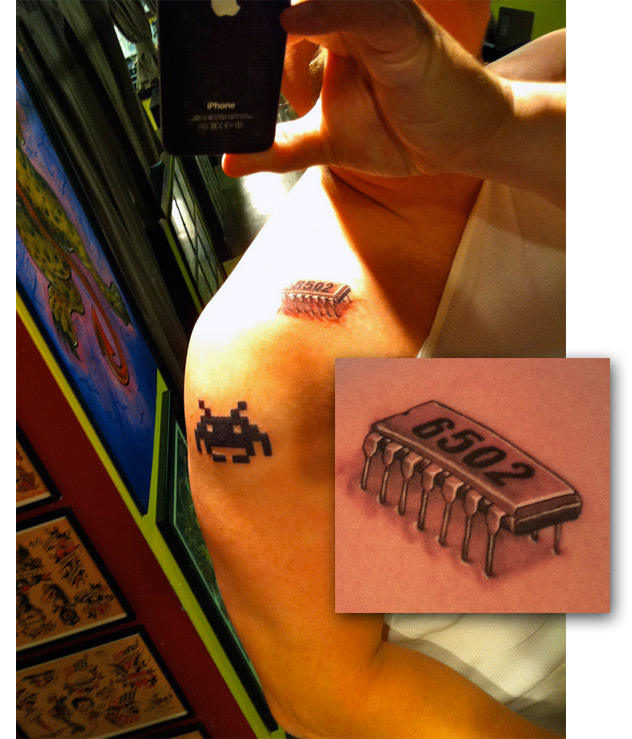
And if you’re off-the-hook hardcore, well, I guess you need the tattoo.

Posted in Gaming | 1 Comment