BlueFlash: Apple II Bluetooth/Disk Controller/Disk Archive Card

Earlier this evening I was reading posts at the 68kMLA Forums when I stumbled upon one of the most interesting retro computing projects I’ve ever encountered. I am speaking of the BlueFlash board, a combination Bluetooth / Disk Controller / Disk Image Archive card for the Apple II.

This amazing piece of hardware allows data (such as disk images) to be transferred from a host machine to an Apple II via Bluetooth (wirelessly) and executed as if running from an actual Apple Disk ][ 5.25″ floppy drive. Vinchysky, the clever man behind this project who began the BlueFlash effort three years ago, achieved this by fully implementing Woz’s ingenious Disk ][ controller card in a Xilinx FPGA, driven by an on-board, 57MHz ARM7 processor. Communications are achieved by way of a standard PC bluetooth dongle plugged into the board’s single USB connector. Disk images can be executed from a flash card inserted in the board’s compact flash slot, or from the board’s 512K of SRAM (acting as dual drives) after direct transfer via Bluetooth from a host computer.

The BlueFlash board is not shipping just yet, but should be soon. This feature-packed expansion card retails for $160 (for board + Bluetooth USB dongle) with an extra dongle for host PC going for an additional $10. I have an Apple IIgs with hard card, but assuming this works well with a IIgs, I’ll certainly take one off of Vinchysky’s hands in short order.

An amazing effort and an amazing piece of hardware that certainly goes a long way towards fulfilling that old mantra: “Apple II Forever.”

::: Digg this story! :::

Posted in Apple II | 13 Comments

NEXTSTEP…In My Pocket

NEXT Computer company logoThe moment I caught my first glimpse of the NeXT Cube and its revolutionary operating system, NEXTSTEP, I was spellbound. Never had a computing system been even vaguely as elegant as what lay before me back in 1989 on the pages of Bruce F. Webster’s The NeXT Book, a highly illustrated delve into the inner workings of NeXT‘s new hardware and software. (As it turns out, The NeXT Book would be my only exposure to NeXT for years – if, despite my lust, the book itself at $22.95 was too expensive to buy, the $6,500 Cube was rather beyond possibility.)

I finally became a NEXTSTEP user in 1994 with the purchase of a 66MHz 486 workstation specifically fabricated to run NEXTSTEP for Intel. It ran the full developer version of NEXTSTEP for Intel v3.2 which retailed for $5,999 ($299 with student discount)! But sadly, within a year I was running Windows (where elegance has no home) on that box thanks to the dearth of mainstream apps available for NEXTSTEP. My prayers were answered, however, several years later with Apple’s announcement that it intended to acquire NeXT and NeXT’s subsequent takeover of Apple. OPENSTEP (basically NeXT’s latest version of NEXTSTEP) was to become the basis for the Mac OS. I ran right out and bought a Mac.

As it turns out, I used that Mac for a couple of years before Mac OS X finally debuted, but on March 24, 2001, Mac OS X v1.0 arrived. NEXTSTEP gave rise to OPENSTEP, which was transformed into Rhapsody, which evolved into Mac OS X. With mainstream apps and everything! I run Mac OS X on three Macs presently and have been using it as my primary OS for over six years now. I know exactly where elegance lives.

And it’s not just me. Apple, presently owning about 5% of the PC marketshare, shipped 1,764,000 Macs this past quarter alone. There are millions and millions of people out there running what could be described as the latest version of NEXTSTEP. I find that so great!

Original iPhone sitting in a dock on a deskHere’s another thing that’s kind of crazy to think about, and is what prompted me to make this post. As I type this, there is an Apple computer featuring advanced graphics and sound, wireless data capabilities of several varieties, a web browser able to view even “Web 2.0” sites, a digital camera, a revolutionary touch-based user interface, running OS X (the modern evolution of NEXTSTEP, mind you), sitting in the front-right pocket of my jeans. Yes, it is the iPhone of which I speak and unless you happen to be dead, you’ve heard of it. And it is astounding…and elegant.

I find the aforementioned to be an interesting sequence to contemplate. I hope you have, as well. I did eventually get my hands on actual NeXT hardware, by the by: a refurbished NeXTstation Turbo Color system acquired for $250 back in 2000. A few years ago I jumped at the chance to pick up an HP 9000 “Gecko,” which also runs NEXTSTEP, for $20 and had it up and running in no time. I’ve had some rather recent fun getting OPENSTEP running on my MacBook Pro and Mac Pro, as well. And I did finally get my own copy of Webster’s great book. I found it on eBay and won the auction a few years ago at $99.

::: Digg this story! :::

Posted in HP, NeXT, UNIX | 6 Comments

Glorious Six Foot Neon Apple Logo Sign Auction

Someone in a recent IRC chat pointed out to me an eBay auction for what might actually be the object on this earth that I would most like to possess, surpassing all other material items by a rather significant margin. More than the fishnet stocking-shrouded leg lamp of the “you’ll shoot your eye out” kid, this is electric sex.

I point you to the six foot tall Apple logo neon sign.

The auction started at $2,500 and is, at the time of this post, up to $4,500 – and the seller’s reserve price has not yet been met. If bidding on this item would not have exactly the same effect on my marriage as engaging in 3-way-sex with a couple of call girls and handing my wife the video, I would be unable to restrain myself from going after it. Alas, I shall not be the one member of the human race able to daily bow down in worship in front of so glorious an icon.

Happy bidding.

UPDATE [10.31.2007]: No, I didn’t break down and bid to win on this one. But a cool $10 on eBay did land me a little goody that glows at least a little Apple Goodness in my own Byte Cellar.

Posted in Apple II | 3 Comments

Apple //c as a Dumb Terminal to my Mac mini

Several months ago – maybe more like a year or two ago now, I purchased an Apple //c in mint condition and didn’t really have a plan for just where I would house this little treasure. You see, my second computer was an Apple //c (after my TI-99/4A), puchased in April 1984. It was a great experience owning and using that machine at the age of 12. I finally sold it and moved to the Mac, and then Amiga, and then Apple II again, and then… Well, let’s not get carried away. This story is about the //c – the //c I recently purchased.

So the //c has been in my office since I purchased it. About two years now, I suppose. I’ve booted it seldom enough times to count on one hand – a sad situation. Well, I recently encountered a story that gave me a reason to use my //c a little more frequently – as in every day. It seems that Paul Weinstein put an Apple //c into his office setting, tied to his Mac mini via serial link, and proceeded to use the //c as a text terminal for IRC chatting. An avid IRC user myself, with a Mac mini and Apple //c already in my office, I had little choice but to folllow his lead. The result is most satisfying.

Sitting next to my office workstation setup is an Apple //c, complete with a 9″ monochrome Apple Monitor //c and stand (all beautifully designed by frog design inc.) serving full time, 8-hour per workday duty as a serial terminal to my my Mac mini. A custom 5-pin DIN (//c end) to 8-pin mini-DIN (Mac style) null modem cable of my own (sloppy) creation ties the //c to a Keyspan dual USB-serial adapter plugged into my mini. The //c is running Modem MGR, a popular and flexible terminal application (three 143K floppies in size) that is providing VT220 emulation. 9600bps seems the fastest that the //c can handle in this configuration – slow, but adequate for the role of a text terminal. (It actually seems pretty fast given that 1200bps is the fastest speed at which I’ve ever used an Apple II terminal emulator – on my IIe with internal Prometheus ProModem 1200A back in 1986.)

The //c spends basically all of its time serving as an IRC chat terminal, displaying a shell session of either irssi or Rhapsody, both terminal-based IRC clients, running on my remote Linux server by way of a secure shell connection. It’s a rather abstracted approach, but it’s great to twiddle the //c’s keys in a meaningful way every workday.

I’m rather enjoying the setup, and it’s certainly generated many a raised eyebrow and curious look as folks pass by my office. At any rate, I hope you’ve enjoyed my tale and my photo gallery chronicling this project.

Also check out:

::: Digg this story! :::

Posted in Apple II, Serial Terminal | 19 Comments

Macintosh Plus Gaming Gallery

I recently sold my original Macintosh 128 to help fund the purchase of a HD camcorder. (I knew I’d never dedicate desk space to it, what with my rather functional Mac Plus setup, and it seemed a shade lonely sitting on the shelf in its carrying bag.) I used the aforementioned Mac Plus to get the system disks all squared away for the buyer. After that was taken care of, I spent some time fiddling with various games on the Plus’ hard drive. It’s easy to forget the kind of fresh, unique titles that a high resolution (512×342 looks pretty tight on a 9-inch screen), monochrome platform brings forth. Some of the games are downright gorgeous.

In an effort to share the experience with those who never owned a compact Mac, I grabbed my camera and tri-pod and started snapping “screenshots” of various titles. Digital photos of the screen, as opposed to honest to goodness screenshots, give a much better feel of the compact Mac gaming expreience, revealing the faint scanlines (as faint as they came, back in its day) and pleasant, blusih tint to the Mac’s screen phosphor.

Grid of Mac Plus screen photos showing games

Have a look at the gallery of shots I’ve placed online. I’m still adding to it, so stop back in a few days and have another look.

Posted in Gaming, Macintosh | 6 Comments

You Are Likely to be Eaten by a Grue

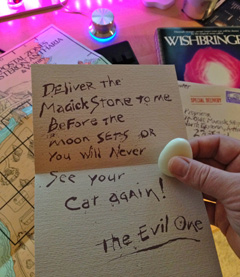
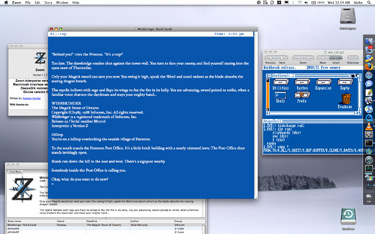
I played it first on my shiny new Apple //c, back in April 1984. (Hey! Our logo graphic is an Apple //c!) I’ve fiddled about with it in years since on various other platforms, but it was the //c upon which I actually spent some time with it. The first game I purchased for that, my first Apple, actually. Zork I from Infocom. One of the most famous works of interactive fiction (or “IF” for sceners). A detailed text adventure with graphics provided by your imagination.

Sadly, I never solved the game. I played a good bit and we traded underground maps back in middle-school, I recall. But I never got around to solving it. My personal favorite of Infocoms gems was Brian Moriarty’s Wishbringer. Great fun solving that, later, on my Amiga 1000 (I was an early Amigoid). It was one of the few games available for the Amiga at the time, ironically. (I actually, recently purchased a full, boxed version of Wishbringer – just to get the whole package, in anticipation of replaying it on a modern Z-Machine interpreter with my wife as a form of TV alternative, but we haven’t gotten around to it yet.) But that’s Wishbringer…and this article is about Zork I.

The point of this post, which I am about to draw to a close, is a certain Gamasutra article entitled “The History of Zork” which crossed my radar in the form of an item in A2Central‘s RSS feed. Give it a read. IF is one of the best protrusions of gaming.

And in related news, Jason Scott, creator of BBS: The Documentary is hard at work on Get Lamp, a text adventure documentary film which will should wrap up in August of this year. Don’t miss it.

Posted in Gaming | 4 Comments

The Saga of my MYST Channelwood Poster

I’d been looking for it for eight years, and I finally got it. A MYST Channelwood Poster.

If you don’t know what MYST is, God help you. Channelwood is one of the “ages” of MYST. My ex-girlfriend and I solved MYST in a 17 hour session stretched across two days back in 1994. I consider that MYST experience to be the most immersive gaming experience of my life.

I first saw the Channelwood Poster on a dated (dead) Cyan store page. It perfectly captured the MYST experience in roughly 24×36-inch form. But it was no longer for sale. A year later I saw it on eBay and bid. High. I got outbid. It went for over $300. I encountered only one other, again on eBay, and got outbid – again, it went for over $300.

MYST600pxOver the years I’ve posted on various gaming forums looking for this poster and a couple months ago someone suggested I email a certain particularly kindhearted woman who is more or less the “office mom” of Cyan Worlds. After discovering her name, I guessed her email address and off went my query. She responded and, as it turns out, they had THREE left in the Cyan Worlds dungeon. I pleaded with her to sell it to me and she said she’d check with Rand Miller, co-creator of MYST. On that same day I sent this kind soul a dozen yellow spring tulips from a local Mead, Washington florist to underscore my begging. As it turns out, Rand Miller noticed them on her desk and asked her about them. She explained what it was all about and he agreed to give me one of the last Channelwood Posters for a donation to the Cyan party fund of an undisclosed amount. The kicker? Rand signed the poster to me! I happily obliged and days later the poster, in excellent condition, arrived at my home.

To prevent a flood of random emails sent to Cyan Worlds, I will tell you that I have been told that the two remaining copies of this strongly sought after poster are going to be sold (likely for substantial sums) at a special, upcoming Cyan Worlds event. So…please do not pester this wonderful woman whom I leave nameless.

I hope you enjoyed my tale. This is unquestionably the gem among my poster collection.

I am currently replaying MYST on my Sony PSP, here 13 years later. Good stuff.

Posted in Gaming | 9 Comments

My Atari 520ST Setup

I’ve mentioned in various posts on this blog that I’ve owned a couple of Atari STs over the years – a 520ST in late ’86 and a Mega ST2 in ’89. I sold them both long ago, but have particularly fond memories of that 520ST, which was a really nice setup, housed in a Micro Mate 520 STation. The last is a rather unique system stand/organizer which I’ve searched for on and off over the years, thinking it would be a great find in case I ever setup another ST system. Well, I found a 520 STation, as reported here back in February. And, as I expected (feared?), the STation lead me to setup a whole 520ST system with which to fill it.

It’s a standard, early model 520ST with 512K RAM and an integrated RF modulator. I’ve got two SF314 (double sided) floppy drives tied to it, along with a classic 15kHz SC1224 RGB monitor. I’ve replaced the keyboard and body plastic on the 520ST with brand new pieces, so it truly feels like a new machine. I’ve had fun playing with it so far, and intend to spend much more time with it in the coming months.

Click the above pic to see my full 520ST gallery.

Posted in Atari | 7 Comments

All Hail Glide!

Remember the first time you were blown away by 3D graphics? I don’t mean sitting in a theatre watching The Last Starfighter, but on a computer or console at home. Yea, Starglider and Virus were awesome, but for me the first time I was floored by 3D was seeing Wipeout for the first time on a Playstation, back in ’96. There’s a second time, but no third, really. The second time was after slipping a 3dfx Vooodoo graphics card into the PCI slot of my 225MHz AMD K6-based PC. Smoother, perspective-correct 3D at four times the res of the PSX. Insane fine.

There were a number of APIs out there used to work Voodoo-support into a game, like Direct3D or OpenGL – but games that looked the best, without fail, used Glide. As Wikipedia tells it,

    Glide is based on the basic geometry and “world view” of OpenGL. OpenGL is a very large library with about 250 calls in the API, many of which are of limited use. Glide was an effort to select those features that were truly useful for gaming, leaving the rest out. The result was an API that was small enough to be implemented entirely in hardware. That hardware was 3dfx’s own Voodoo cards. This led to several odd limitations in Glide — for instance, it only supported 16-bit color.

I still do a bit of Glide gaming on my 700MHz P3 Windows 98SE box (used primarily for retro emulation) which sports an AGP Voodoo3 3000. (I’m a Rune nut.) So it was with no small degree of happiness that I happened to stumble upon an article this morning detailing the Best 3dfx Glide Games. Whether or not you dabbled in Voodoo in your distant past, have a look – good stuff, to be sure.

Posted in Multi-Platform | 1 Comment

40 Year Console History Pictorial

It leaves out a lot and really is to gaming what “We Didn’t Start The Fire” is to world history, but it’s surely worth a look:

Wired’s Console Portraits: A 40-Year Pictorial History of Gaming

Game on.

Posted in Gaming | 3 Comments